|
McCloud River Railroad Models McCloud River Ballast Cars by Sierra Nevada Car & Foundry and Charlie Joslin |
|
|
Three dimensional printing has opened up countless new possibilities in the scale model world and has allowed smaller or newer companies and individuals to create new models of obscure prototypes. Sierra Nevada Car & Foundry is one such company, and they recently started producing very well done resin printed models of Great Northern 22-foot ore jennies. These cars have a fascinating history, but to date they have only ever been offered in HO scale as a polyester with metal fillings kit produced by Westerfield over the last several decades and at least one run of brass imports. Charlie Joslin, who's McCloud- themed layout is profiled in this section, purchased several of the SNC&F cars and is modifying them to represent a few of these cars that ended up in ballast service on the McCloud River Railroad. This page will feature in turn information about the prototype, the SNC&F models, and finally Charlie's modifications to represent the McCloud ballast cars. |
|
|
The Prototype The heavy haulage requirements of the iron ore industry in the upper Midwest led to the early development of short but exceptionally well built hoppers cars designed to handle the heavy loads. The Pressed Steel Car Company in 1899 built fifty 22-foot long cars for the Great Northern Railroad using pressed steel shapes, the first steel hopper cars that road owned, followed by 450 more the following year. Some of these cars belonged to Great Northern subsidiary Eastern Minnesota Railway. In 1902 Great Northern returned to Pressed Steel for another 500 or so cars, this time built from structural steel shapes. As built all 1,000 or so of these cars Great Northern owned had two knock holes cut through the outer wall and hopper bay parts of the car, with a flap covering the holes on the inside of the hopper bay; during the summer months poles would be inserted through those holes to knock loads out of the cars, then in the winter steam pipes could be inserted to thaw frozen loads. Sometime after a few years of service GN cut another three holes into the sides of most but not all of the fleet. All of the cars as built also had a walkway running along the right side of the car. Great Northern retired most to all of their 1899 and 1900 built cars in 1924 and sold most of them to a pair of equipment dealers, Hyman-Michaels or United Commercial Company, who resold most of them to logging or industrial railroads primarily across the west for use either as ballast cars, in construction projects, or in some form of aggregate service. A likely partial list of the railroads upon which these cars operated includes Melones Dam project, Pacific Gas & Electric; Coos Bay Lumber/Georgia Pacific; Apache Railway; Sierra Railway; Longview, Portland & Northern; Yreka Western; Crown Willamette Paper; Almanor Railroad; The Red River Lumber Company; Amador Central; Medford Corporation; Yosemite Valley Railroad; Heber Creeper; Santa Maria Valley; Kaiser Steel; and McCloud River. McCloud River got their first taste of these cars when Pacific Gas & Electric acquired some number of them for use in the Pit River hydroelectric projects supported by the Pit River Railroad. McCloud either did not or could not acquire any of the cars for ballast service when that job wrapped up in the later 1920s, though one of the cars ended up on the neighboring Yreka Western Railroad. Great Northern continued using the 1902 built cars for years afterwards, and they converted many of them into company service cars, with some receiving ballast or center dump doors in place of the original two hopper configuation. McCloud River acquired their first group of five cars directly from Great Northern in September 1939, numbered 1791-1799, odd nunbers only. In July 1950 the railroad bought another five cars from GN, these numbered 1801-1809, again odd numbers only. All of these cars were from the 1902 order. Some of the cars arrived with ballast doors already in place, while others still had the original hopper configuration. McCloud equipment records show the #1791 retired in 1954; #1793 retired 1954; #1795 retired by 1963; #1799 retired 12/31/1953; #1805 retired 1954; #1801 retired 9/1982; and #1809 retired 9/1982. By 1972 the numbers McCloud applied had largely worn off, and around that time the railroad repainted and renumbered the four cars still on the property to #1805-#1808, all numbers, but did not record which cars got which numbers at least in surviving records. There are conflicts between the written records and car numbers that are not resolved in any surviving or available resources. Only one of these cars, the #1808, survived past the early 1980s, and it remains in McCloud today. 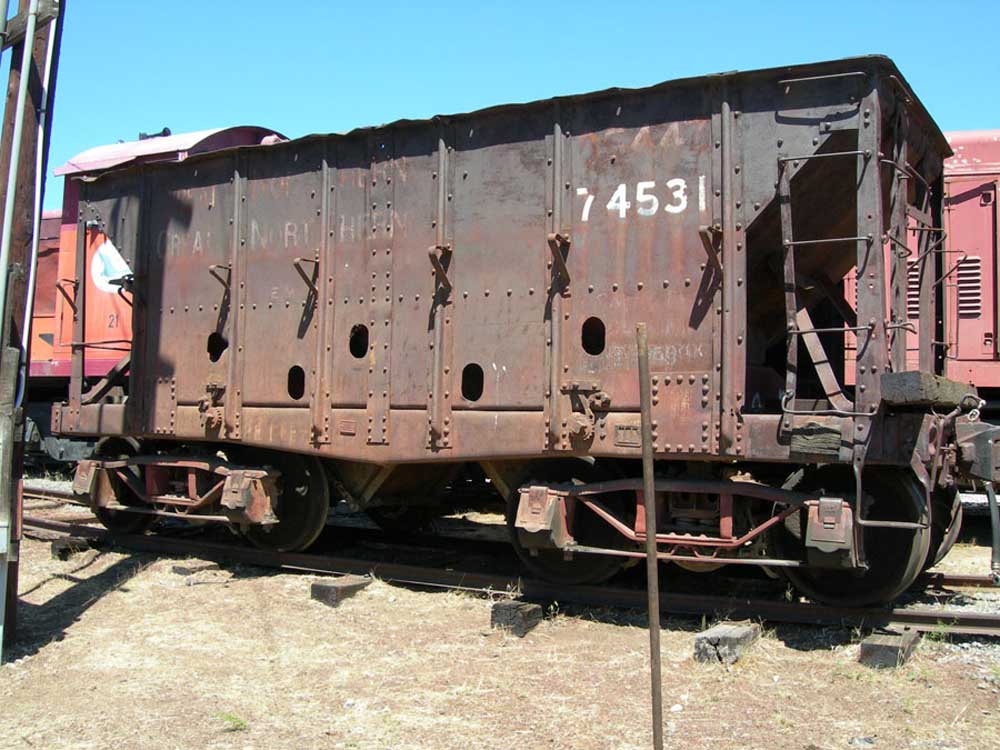 Yreka Western's ballast hopper, which at one time served PG&E on the Pit River project as their #19, is from the 1899/1900 lot of cars. The primary spotting features of those cars were the fishbelly frame and the steel riveted plate running up the middle of the car. Jeff Moore photo. 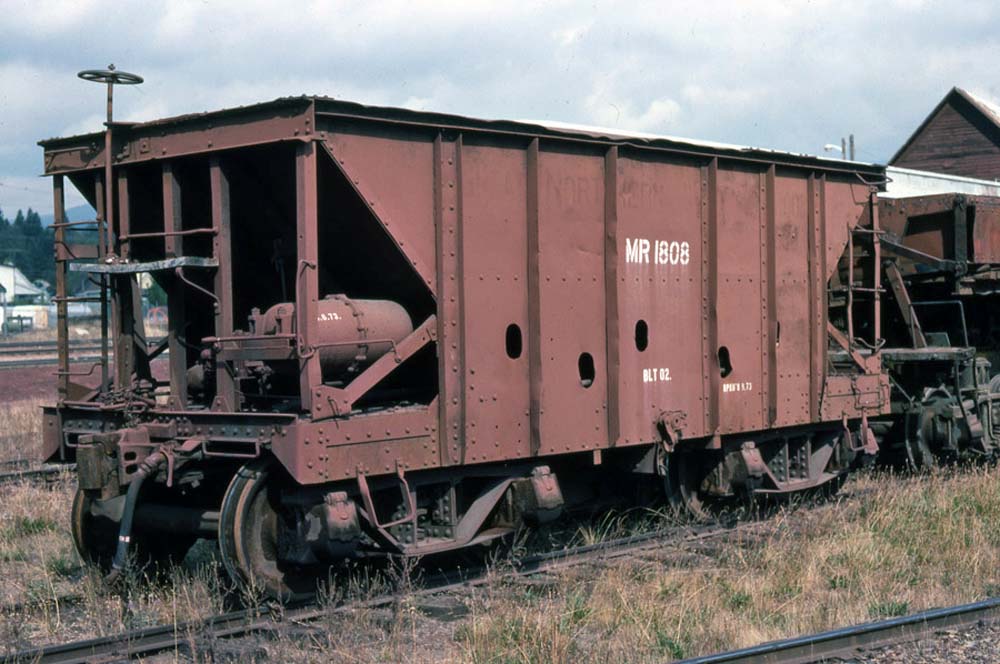 McCloud River #1808 is from the 1902-built lot of cars, the primary differences are the straight side sill and lack of the center steel plate on the side of the car. McCloud removed the running boards on the remaining cars around the time they repainted them. Pat Holden photo, Jeff Moore collection. |
|
|
The Model As noted, HO scale offerings of these cars has been limited to at least one run of brass imports and the Westerfield kit. Westerfield in its most recent form ceased production in 2026 and the business is now for sale. Sierra Nevada Car & Foundry started operations with a goal of producing some of the specialty cars, equipment, and details typical of the mountain railroads of California and Nevada, which now includes the Great Northern PSC ore jennies. SNC&F initially offered the cars with five knock holes and with or without the walkways, plus a three hole version at the apparent request of a customer, though no evidence of these cars ever having three holes seems to have surfaced. The company is in the process of finalizing the original two hole configuration. These models are based off of the Sierra Railway cars preserved today at Railtown 1897 State Historic Park in Jamestown, California, and as such are representative of the 1899-1900 version of the prototype. The models are impressive and capture many fine details of the cars. SNC&F ships the cars painted a flat black and with metal wheels and Kadee magnetic couplers. I acquired several of the cars with and without the side walkways, photos of the cars are below. The company maintains a website providing instructions as to how to order the cars. Sierra Nevada Car & Foundry Website 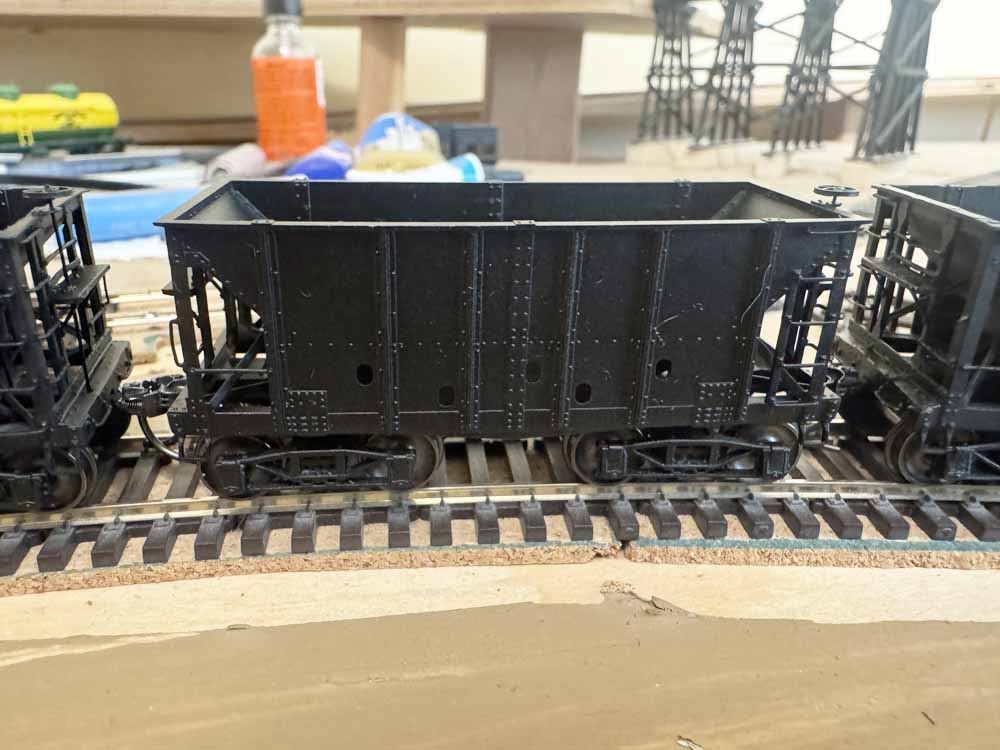 Close up of one of the cars. Parts breakage has been an issue, but SNC&F has been improving their packaging and shipping, and mine arrived with only one stirrup step broken off the car. 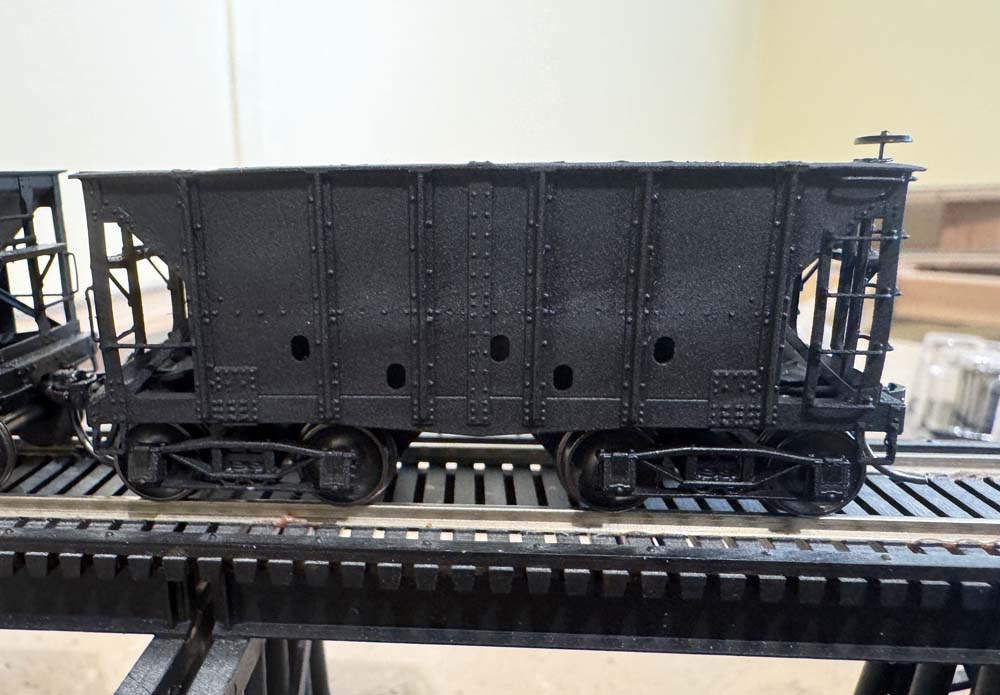 Another view of the car. While the trucks swivel the couplers do not, it remains to be seen how that will work on the railroad. 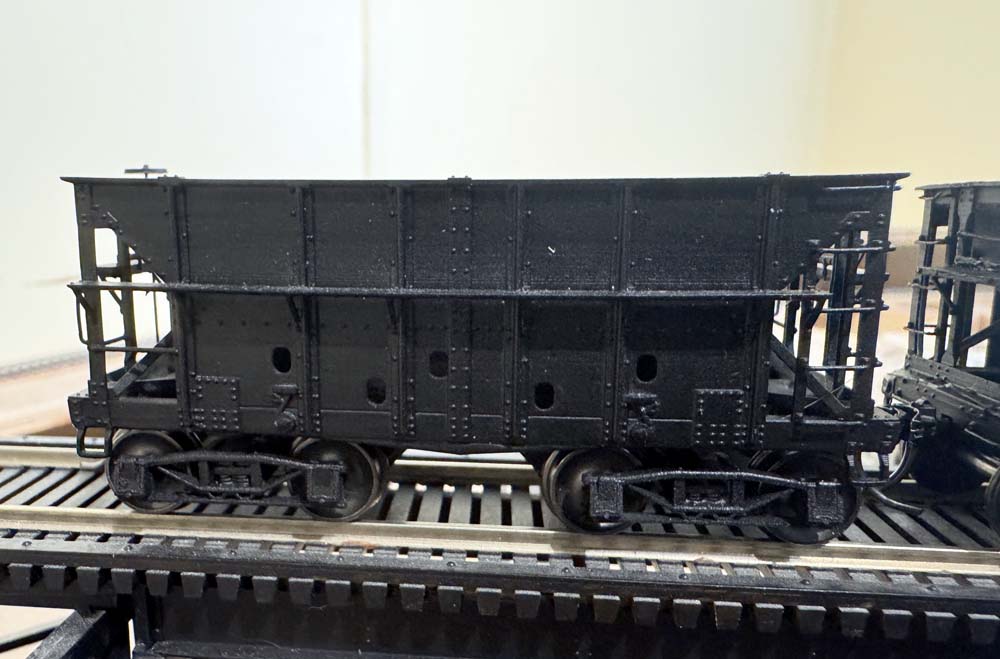 Close up view of the version with the walkway. 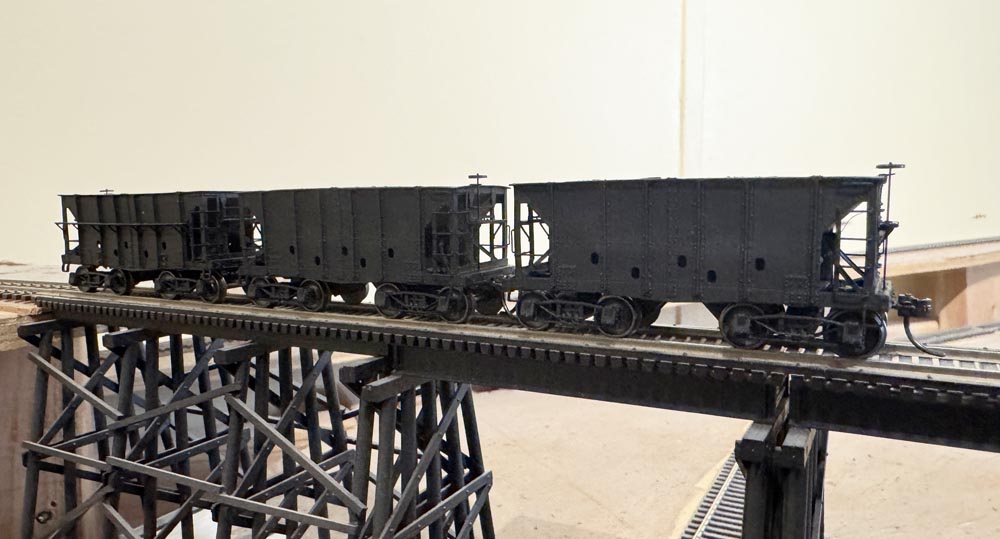 A mixture of three of the cars with and without walkways. |
|
|
Charlie Joslin's Conversion to MR Ballast Hoppers Friend of the site and prolific McCloud River modeler Charlie Joslin acquired four of the cars for his layout. The models as discussed above are all representative of the 1899/1900 version of the prototype, while all ten cars McCloud owned came from the 1902-built lot, which have a couple glaring differences from the earlier cars, most notably the straight side sill and lack of the riveted steel plate in the middle of the car. Charlie spent considerable time looking at the various photos available of these cars on this site and others, and chronicalled his steps in modifying these cars to more closely resemble the McCloud cars. 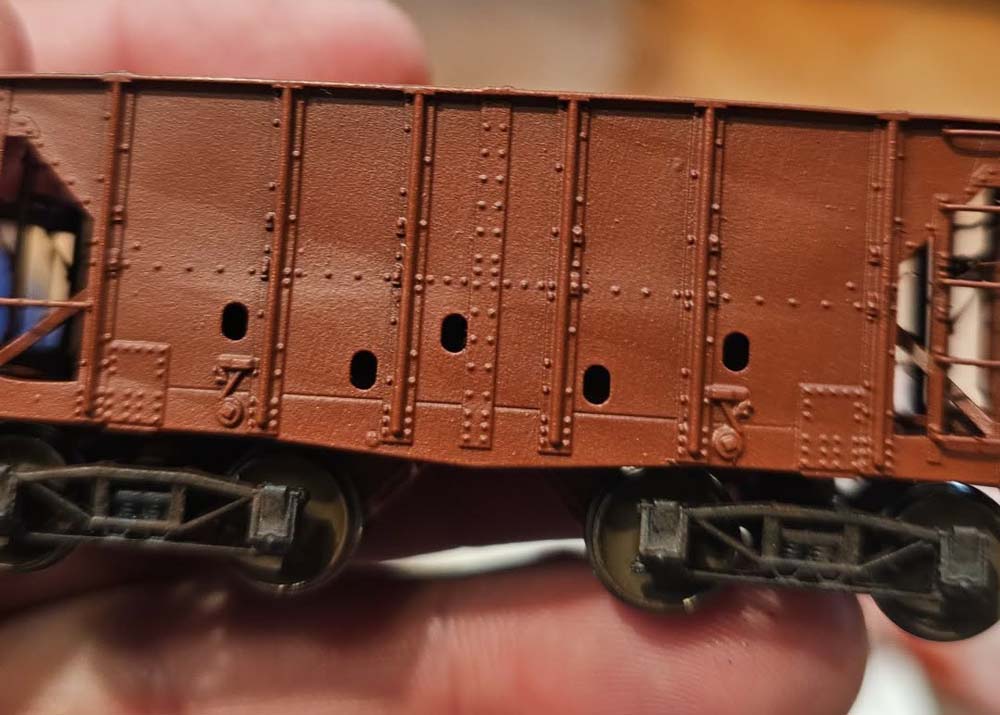 First thing Charlie did after getting his cars was paint them boxcar red. 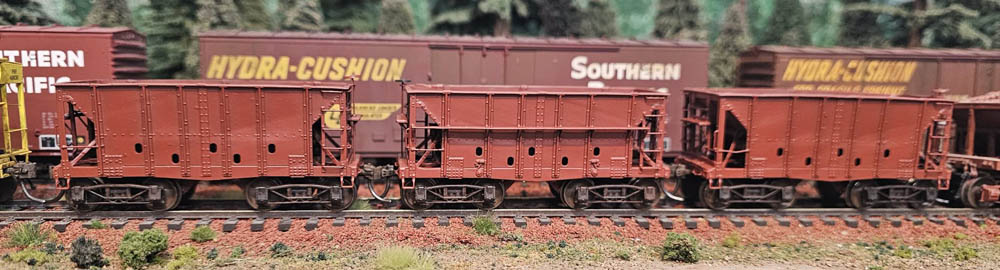 The three cars after getting a first coat of paint. 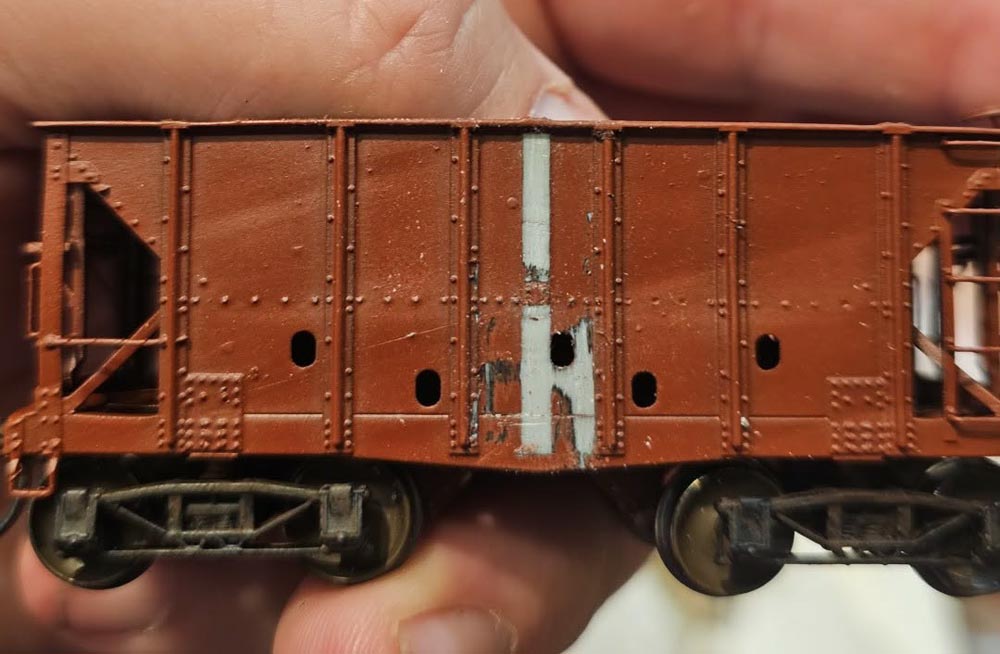 It was at this point in the project when Charlie noticed the rivited plate on the model did not exist on the prototype cars, so he carefully removed them from the cars. 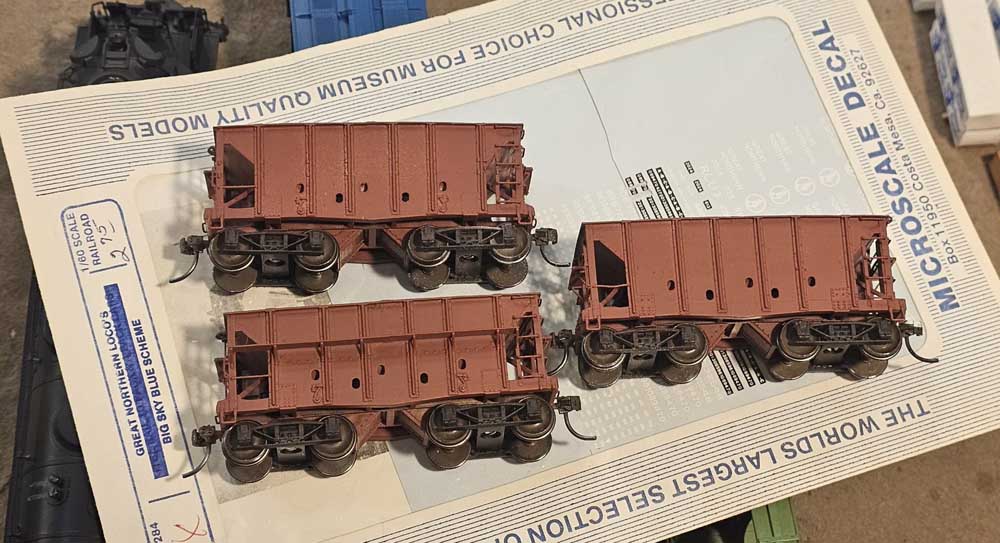 Charlie applied another coat of boxcar red once the center plate had been removed from the cars. 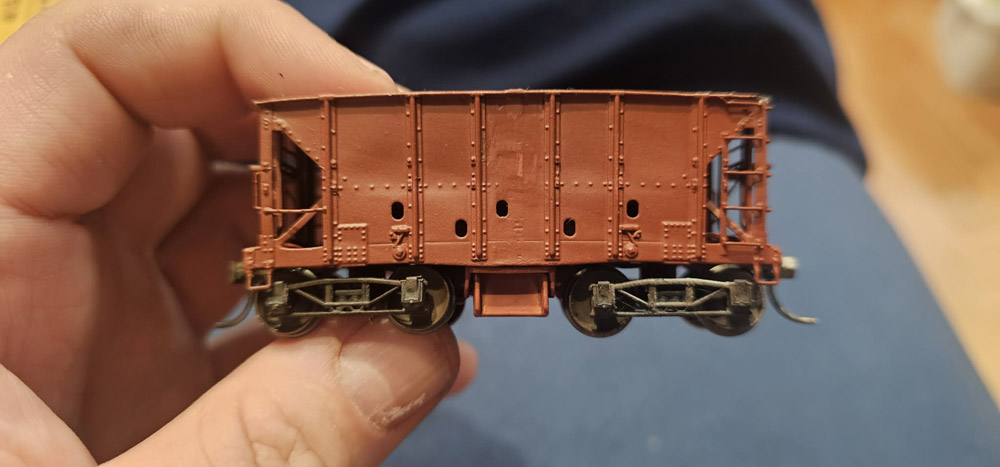 The next detail Charlie noticed was the ballast door on a few of the cars, so he retrofitted one with that detail part. 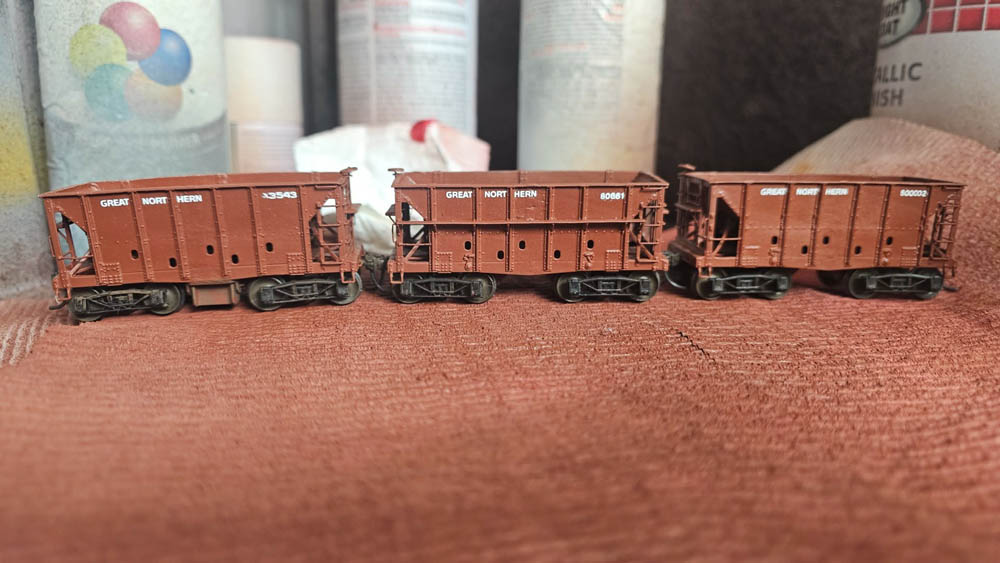 Charlie really wanted to create the "ghost lettering" effect of the GN name and numbers appearing through more recent paint jobs, so he lettered the three cars at this point in the process. 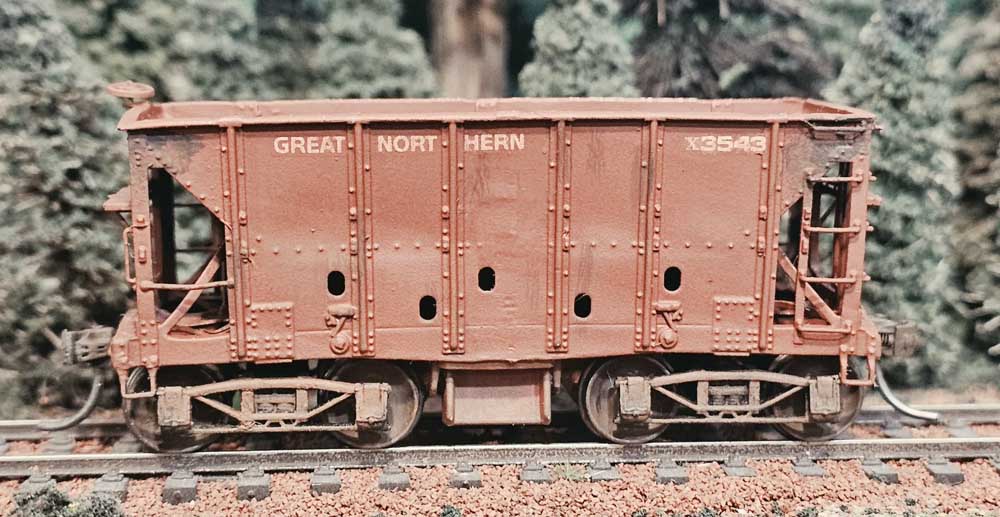 Charlie then started applying additional light coats of paints and washes to get the effect he wanted. 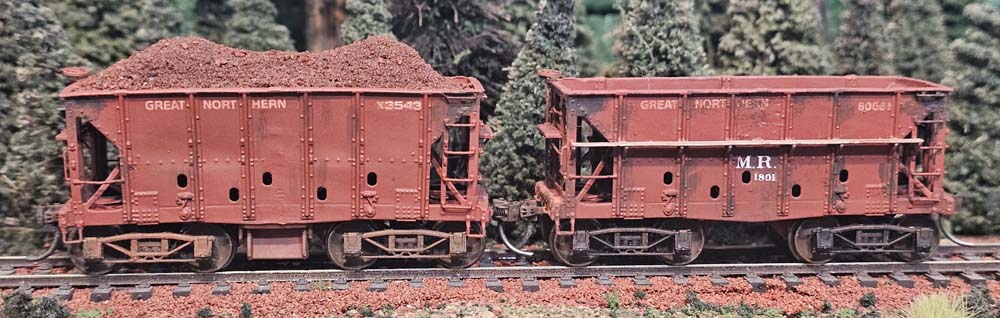 As of mid-September 2026 Charlie has finished two of the cars, is working on the third, and is preparing to start work on a fourth. 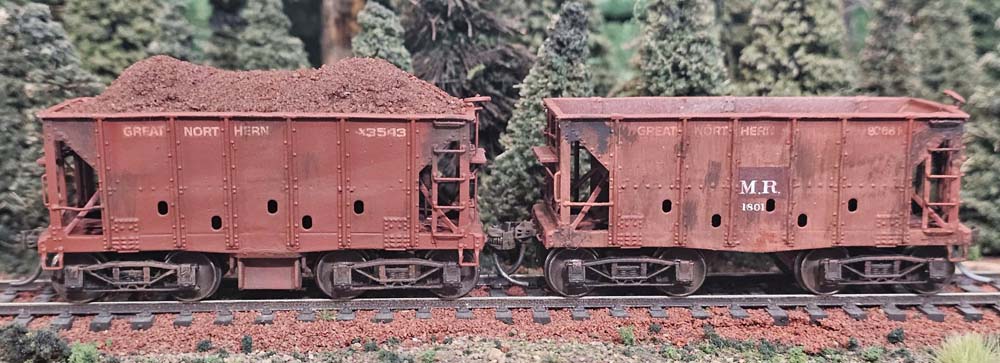 The other side of the two completed cars. 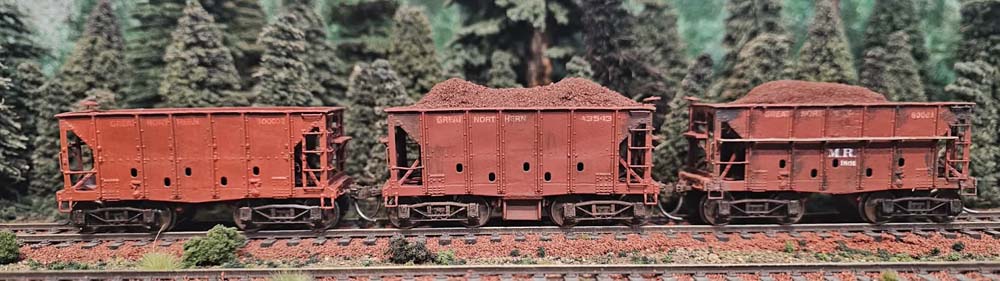 Charlie intends to complete the third car on the left as the #1808, but needs to continue experimenting with paint until he finds a closer match. He plans to model his fourth car as MR 1805 as it appeared about 1980. |
|
|